

This month, I'm absolutely delighted to welcome the wonderful Julia Bradbury to the guest blog seat of Connecting Conversations!
For me, Julia's work has always beautifully reflected the core principles of social prescribing and wellbeing — so when I had the pleasure of meeting her last year at the Integrative and Personalised Medicine Conference, I simply couldn't miss the opportunity to invite her to share her story with us.
Julia is an Irish-born British television presenter, Sunday Times bestselling author, and passionate advocate for health, nature, and wellbeing. Over a career spanning more than 20 years, she has become one of the nation's most familiar and trusted faces — best known for her high-profile presenting roles on Countryfile, Cornwall & Devon Walks with Julia Bradbury, and many other much-loved programmes including Watchdog, Top Gear, and Britain's Best Walks.
Known for her warmth, authenticity, and gift for storytelling, Julia has inspired countless people to reconnect with the outdoors, transforming walking into both an accessible pastime and a genuinely powerful wellbeing tool.
Her health journey has also given rise to two remarkable books. Walk Yourself Happy became a Sunday Times bestseller, and her follow-up, Hack Yourself Healthy, went one step further — reaching the coveted Number 1 spot on the Sunday Times bestseller list. Together, they represent Julia's deeply personal and practical approach to health, drawing on her own lived experience to offer readers real, meaningful tools for living well.
Alongside her broadcasting and writing career, Julia co-founded The Outdoor Guide Foundation, which encourages children and families to engage with nature while championing greater accessibility to outdoor spaces for all.
Julia's work resonates strongly with the principles of social prescribing. Through her television programmes, books, advocacy, and charitable work, she consistently highlights the profound impact that walking, nature, and mindful outdoor experiences can have on our mental and physical health — from reducing stress and improving clarity of mind to encouraging movement, connection, and community. Her work is a compelling, real-world demonstration of just how powerful nature-based approaches can be in supporting healthier, happier lives.
By sharing scenic routes, championing participation, and making the outdoors feel genuinely welcoming and achievable, Julia bridges the gap between inspiration and practical action in the most beautiful way.
Her award-nominated documentary, Julia Bradbury: Breast Cancer and Me, brings yet another dimension to this commitment. In it, she openly and courageously shares her own experience of illness and recovery — exploring resilience, wellbeing, and the vital role that outdoor activity can play in supporting mental health through life's most challenging moments.
I hope you enjoy her blog as much as I do. Happy reading!
In this life there are few things we can be sure of - but one is that we will die. There's nothing we can do about it in the end - but there are things we can do to prolong the inevitable. Over the past few years I've been on a mission to explore what those things are.
In 2021 I received a breast cancer diagnosis. In that moment your world stops. Death becomes a very harsh reality. As a mother of three young children, my mind ran through all the possibilities of what might and might not happen. I wanted to be there for them for many years to come - and to do that I knew I needed to fight this with all that I had.
In many ways I was lucky - I didn't need to have chemo or radiotherapy. In October 2021 had a single mastectomy which took out all of the cancerous tissue. From that I could start not only my road to recovery but also start a journey of discovery into the steps I can take to reduce the risk of the cancer returning and to improve my longevity.
In September 2025 my latest book, Hack Yourself Healthy, was published. For it I became what I call a "crash test mummy" - exploring some of the lifestyle changes you can make to extend your health span with the help of experts within their respective fields - some relating to what is considered modern medicine, others from practices that are thousands of years old. The great thing is, on the whole, they are things that everyone can do and don't have to cost the earth.
The single biggest contributing factor to longevity, both your healthspan and lifespan isn't your lifestyle, diet or exercise regime (although these are all key players) - it's your lung capacity. All too often we only use the top parts of our lungs with shallow breaths. We often over breathe - and that isn't great for us. Patrick McKeown, an expert in Buteyko breathwork and the founder of the Oxygen Advantage programme, explains why: "There's a common belief that breathing more air means more oxygen for the body. But that's not how it works. For example, when you hear people taking loud, deep breaths during a yoga practice, it may seem relaxing, but it can actually reduce oxygen delivery to the brain, muscles and vital organs. Breathing too heavily or too fast, especially through the mouth, causes too much carbon dioxide to be lost. This leads to blood vessel constriction and makes it harder for oxygen to move from blood vessels to tissues." Relearning how to breathe has been a gamechanger for me. Patrick describes it as LSD breathing - light, slow and deep. Learning how to do this can help work the full extent of your lungs, helping to increase your lung capacity.
In recent years there has been an increase in people delving into what is known as contrast therapy - ultilising the power of heat and the cold. Scandinavian countries are known for their love of saunas - in Finland you'llfind more saunas per capita than in any other country in the world. As well as having a social function, they are also a key player in boosting your immune system and aid the development of skeletal muscles. Sitting in a sauna exposes the body to a short term stress (known as a hormetic stress). To counter this, the body generates heat shock proteins. The more you do it, the more your body becomes accustomed to the stress - and can help you deal with stress in other parts of your life. It's the same with cold exposure.
Commonly associated with the Dutch extreme athlete, Wim Hof, cold exposure has also seen a surge in popularity. Whether taking a dip in a body of open water, turning the shower temperature down for a cold blast or sitting in an ice bath for short periods have been proven to boost your immune system and reduce your self reporting of sickness. You come away from it feeling happier, healthier and stronger - more so when combined with breathing exercises.
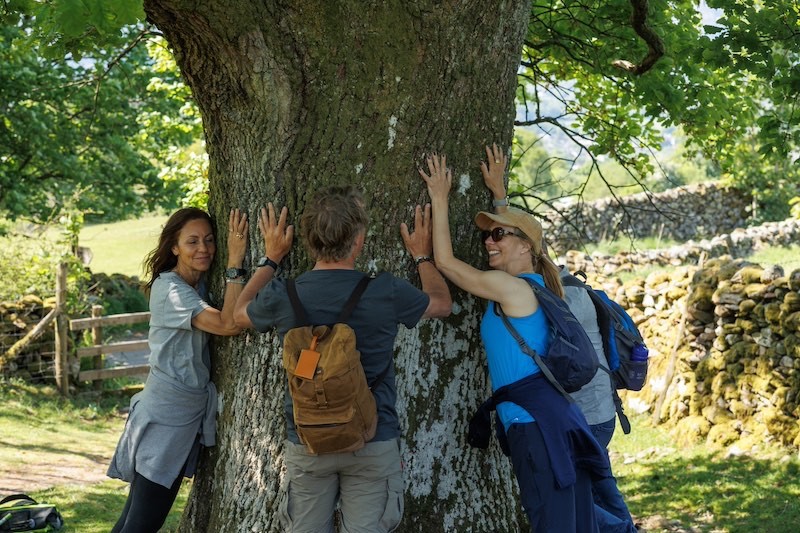
I make no secret of being an addict. I'm a nature addict. There is little else I love more than spending time outside. As I embarked on my road to recovery following my mastectomy, getting outside each day to connect with nature made the difference. It's something that has been known for millenia. The ancient civilisations of Greece and Rome understood the power of blue space (water) and green space for wellbeing. Florence Nightingale during the Crimean War noticed that her patients who had a view of nature recovered quicker than those who didn't.
In the late 1970's / early 1980's Japan saw a spike in the number of people being diagnosed with cancer and autoimmune diseases. Wanting to curb this, the Government of the time turned to the world of science to discover what they could do. It was a study from Dr Qing Li that stood out - looking at how the immune system of trees support and mirror our own. This led to a practice which is called Shinrin Yoku - or forest bathing as we more commonly know it in the west. In essence it's about spending mindful time out in nature. Being conscious of our place in the greater ecosystem, and in doing so we boost our immune system through the absorption of phytoncides (volatile organic compounds that are emitted by trees and plants). Spending several hours in a green, forest environment has been proven to boost our immune system for up to 28 days through an increase of NK (natural killer) cells, special white blood cells that help boost our immune system. If you can do that in one go - that's amazing. The Finnish Forest Institute suggests that just 20 minutes a day out in nature can reduce your blood pressure and raise your overall feeling of wellbeing which is perhaps more achievable in day to day life.
Studies have shown that it can take 66 days to form a new habit. The first 22 days you are fighting against what was and what you are trying to bring in. The middle 22 days you find balance. In the final 22 days the new habit becomes the norm. Forming new lifestyle habits isn't going to happen overnight - but taking that first step will make a difference and start you on your journey to longevity and wellbeing. Just remember the words of Vincent van Gogh - "great things are done by a series of small things brought together".
Ultimately, these simple, evidence‑based lifestyle shifts show exactly why social prescribing matters—because when we connect people to the everyday practices that strengthen their bodies, minds and communities, we give them the tools to live longer, healthier and more fulfilling lives. And from my own crash‑test journey, I know how powerful it is to have someone walk beside you as you try to build new habits, which is where social prescribing link workers make all the difference: they listen, they guide, and they help people find the small, meaningful changes that fit their lives—one step, one breath, one day in nature at a time.
Julia Bradbury is an author, broadcaster and co-founder of The Outdoor Guide, a website dedicated to helping more people get outside and explore on foot. Her latest book, Hack Yourself Healthy is a Sunday Times Number 1 best seller and is available now from all good booksellers.
All images by Anna Bailey.
When you subscribe to the blog, we will send you an e-mail when there are new updates on the site so you wouldn't miss them.
Comments